A teacher in Harare wants her third payroll loan and would apply on her lunch break if she could. A woman who sells clothes at a market in Chitungwiza has the turnover for a stock loan but no utility bill in her own name. A farmer outside Mutoko needs inputs before the rains, and your nearest office is a day's travel away. And a buyer has just asked you to finance eighty of its contract growers before planting.
If you run or manage credit at a microfinance institution with a mixed book of payroll, SME, agri and order finance loans, these are your borrowers. They're completely different people, and one front door won't suit them all.
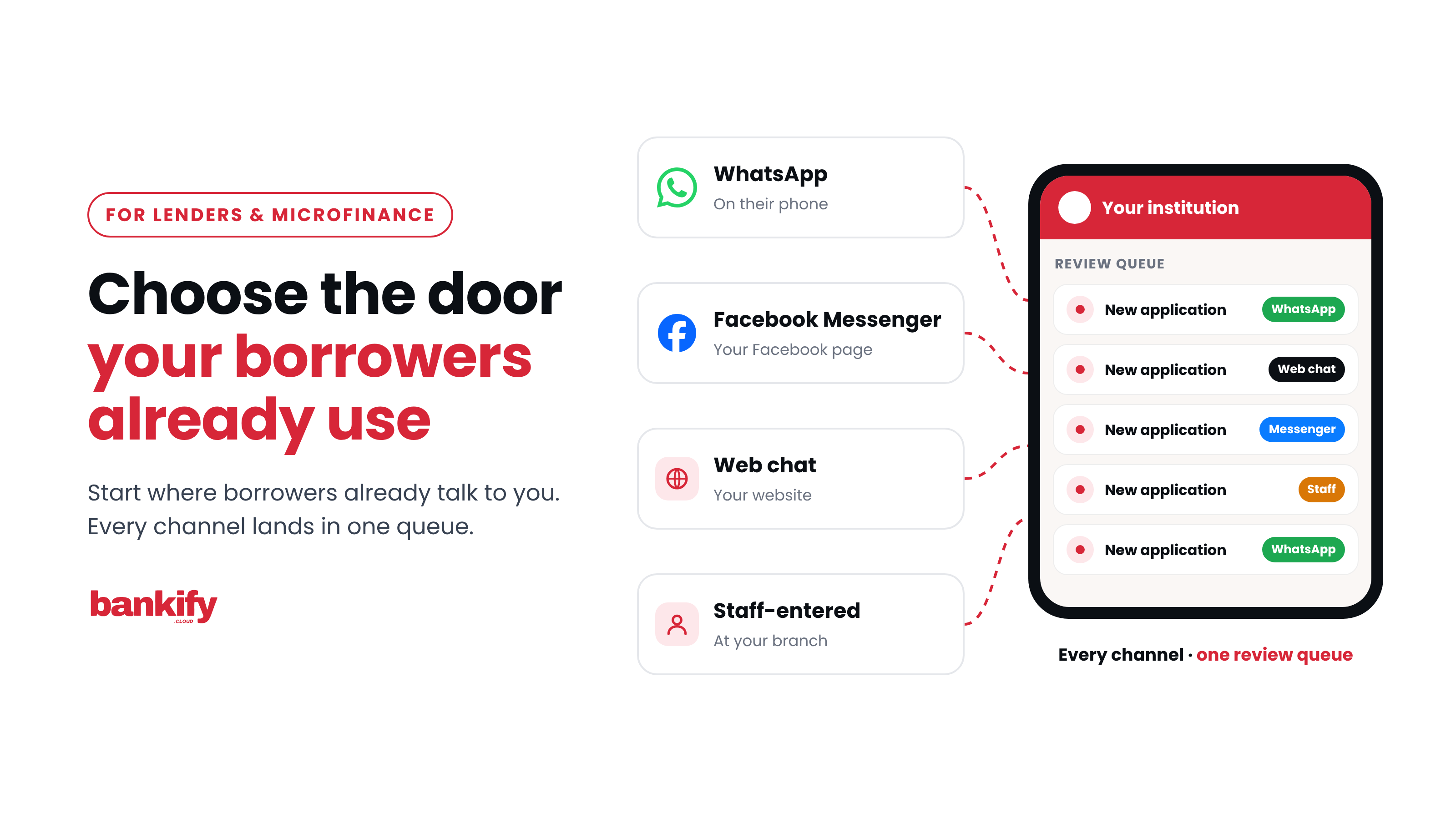
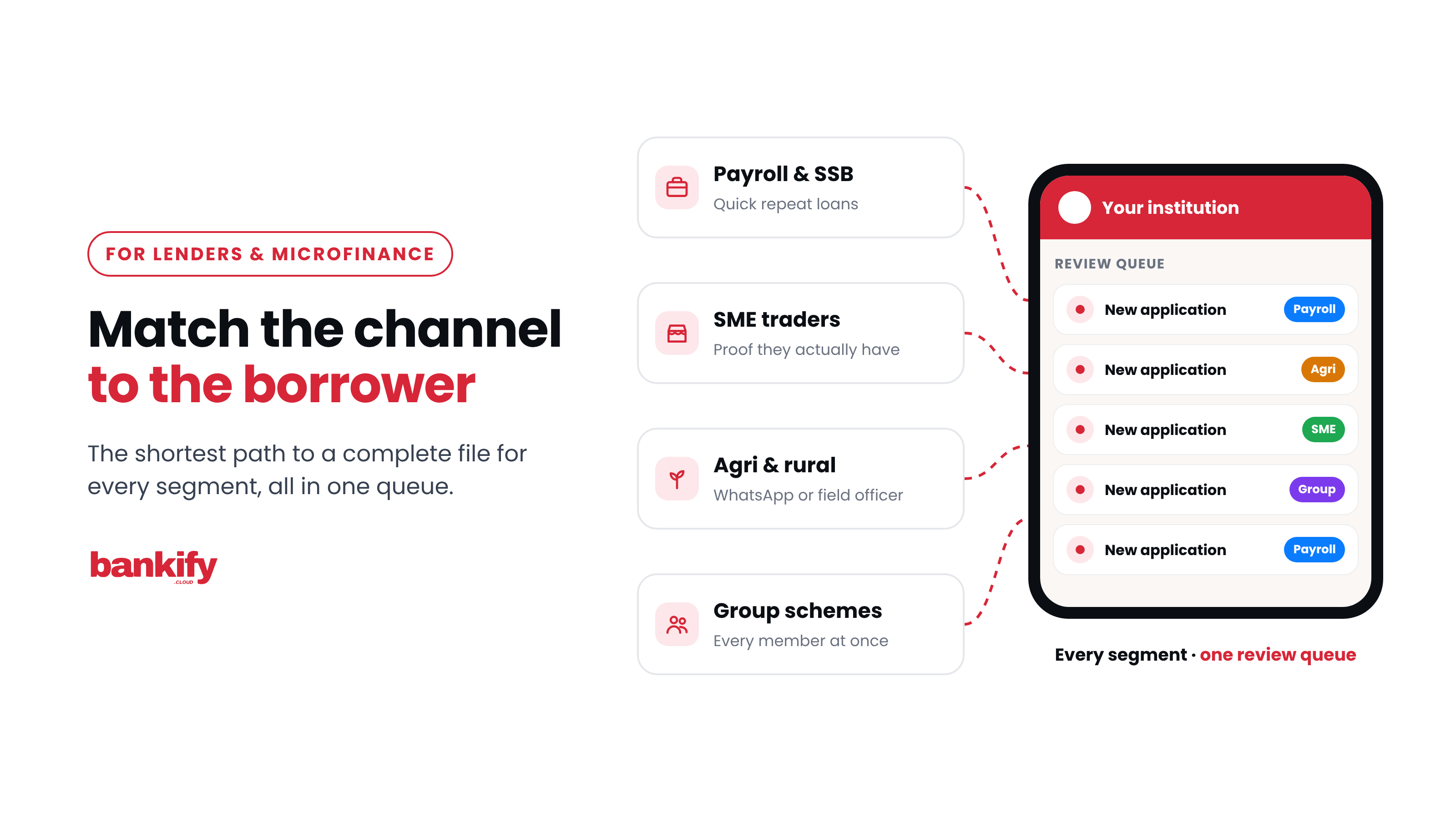
Give each segment the shortest path to a complete file: the channel it already uses, the documents its product actually needs, and a person ready to help where a phone can't.
Four borrowers, four different hurdles
Each segment stalls at a different point. Knowing where is half the design.
Where each segment gets stuck
Payroll and SSB
The borrower is easy to verify, but each new loan can still mean another trip to the branch.
SME and informal traders
The turnover is there, but the utility bill is often in a landlord's, husband's or parent's name.
Agri and rural
The borrower is far from your office, and the loan has to land before the season does.
Group and outgrower schemes
Dozens of applications arrive in the same few weeks, all needing the same checks.
The segment grid
| Segment | Where they apply | Documents that matter | What helps most |
|---|---|---|---|
| Payroll and SSB | WhatsApp, at work or at home | ID, payslip | Returning borrowers sign in instead of enrolling again |
| SME and informal traders | WhatsApp, between customers | ID, proof of residence, proof of income | A broad list of accepted proofs of residence |
| Agri and rural | WhatsApp where there's signal; a field officer where there isn't | ID, proof of residence (often a headman's letter) | Staff-entered applications in the same queue |
| Corporate and order finance | Web chat or WhatsApp, from an office | The corporate pack | Every document read as it arrives |
| Group and outgrower schemes | WhatsApp, each member on their own phone | The same set for every member | Many applications in progress at once |
Payroll and SSB: make the repeat loan quick
Payroll borrowers come back. The first application carries the work: ID, proof of residence and a payslip. After that, a borrower who enrolled on WhatsApp signs in with her PIN instead of enrolling again. In Bankify, documents other than the national ID are treated as valid for 90 days from upload.
Each payslip is also checked as it arrives. Bankify compares the pay it reads from the payslip with the salary the borrower stated, within a tolerance your institution sets, and flags a mismatch for your officer (Bankify Customer Self-Service).
SME and informal traders: accept the proof they actually have
For a market trader, the hardest document is usually proof of residence. Bankify's accepted list is deliberately broad: a utility bill, a bank statement, a lease, an employer letter, a sworn affidavit, or a letter from a councillor or headman.
One accepted proof
- Utility bill in her name
- Or come back later
A broad accepted list
- Utility bill or bank statement
- Lease or employer letter
- Sworn affidavit
- Councillor's or headman's letter
A trader who would have been told to come back can finish her application the same day, from the stall, with the document she has.
Agri and rural: meet the borrower where the signal is
ZimStat's 2022 census preliminary report found 61.4% of Zimbabweans living in rural areas, and DataReportal counted 38.4% of the population as internet users at the end of 2025 (Digital 2026: Zimbabwe).
Why agri needs two doors
61.4%
of Zimbabweans live in rural areas
ZimStat 2022 census, preliminary report.
38.4%
of the population used the internet
End of 2025 (DataReportal 2026).
So agri lending needs two doors. Farmers with a smartphone and signal apply on WhatsApp. For those without, your field officer captures the application on a visit, and in Bankify it lands in the same queue to the same standard. Agri loans also run to the season, so a front door that's open before your officers reach every district helps the loan land before planting.
Corporate and order finance: a desk, a document pack
A company borrowing to fulfil an order applies from an office, often with a director at a computer. The file is a pack, and Bankify reads each part as it arrives: the CR14, CR6, certificate of incorporation, memorandum and articles, tax clearance and a borrowing resolution. A corporate application can only be approved once the person applying is a verified representative of the business.
Web chat on your own website suits a multi-document pack sent from a desk. WhatsApp suits a director who runs the business from a phone.
Group and outgrower schemes: many conversations at once
When a buyer or an employer brings you a whole group, the intake happens in a few weeks. On WhatsApp, each member messages your number from their own phone and applies in their own conversation, all at the same time, instead of queuing for appointments.
Bankify allows one live application per product per calendar month for each borrower, so a duplicate is caught at submission. Members without a smartphone can apply through a field officer on the day of a scheme meeting, into the same queue.
One engine underneath
Each segment takes a different path, and all of them arrive in the same place: the same KYC rules and one review queue. Document checks pass or flag an application, and your officer makes the decision.
Talk to us about your product mix. Book a 15-minute walkthrough and tell us which segments you lend to; we'll show you how each one would apply. If you missed the last article, read WhatsApp, Messenger, Web Chat or an App? Choosing Your Self-Service Channels.
Next in this series: Start With One Channel, Not Four.