The lease is on the desk. It's for a small office in Masvingo, the town your loan officers keep mentioning because borrowers there call to ask when you're coming. Sign it, and before the first loan goes out you'll be paying for premises, fit-out, two or three salaries, security and the rest.
If you run a microfinance institution with one, two or three offices, you know this decision. Growth usually means another branch, and another branch is a large, fixed commitment made on a feeling about demand.
A digital front door lets you test that demand first: borrowers in the new district apply on WhatsApp from day one, and you open the branch where the applications show it will pay.
What a branch commits you to before the first loan
Every new office carries costs that start the day you sign, long before it has a loan book to pay for them.
What you commit to before the first loan
Premises
The lease, the deposit, the fit-out and the furniture.
People
Loan officers, someone to run the branch, and security.
Running costs
Power, connectivity, transport and the day-to-day cost of keeping the doors open.
Time
The months it takes a new branch to write enough loans to cover itself.
These costs are fixed. They're the same whether the district turns out to be your best market or a quiet one.
What a digital front door costs
Bankify's published prices for Customer Self-Service start with one WhatsApp number.
Bankify Starter, from the pricing page
$199
per month
One WhatsApp number and about 300 applications a month.
$400
one-off setup
Covered in full by the $500 paid pilot.
2 weeks
to go live
The Starter plan's stated setup time.
The Growth plan, at $449 a month, adds Facebook Messenger and a chat widget for your website, up to three WhatsApp numbers and about 1,500 applications a month. On annual billing, both plans charge twelve months for the price of ten.
Test several districts on one subscription
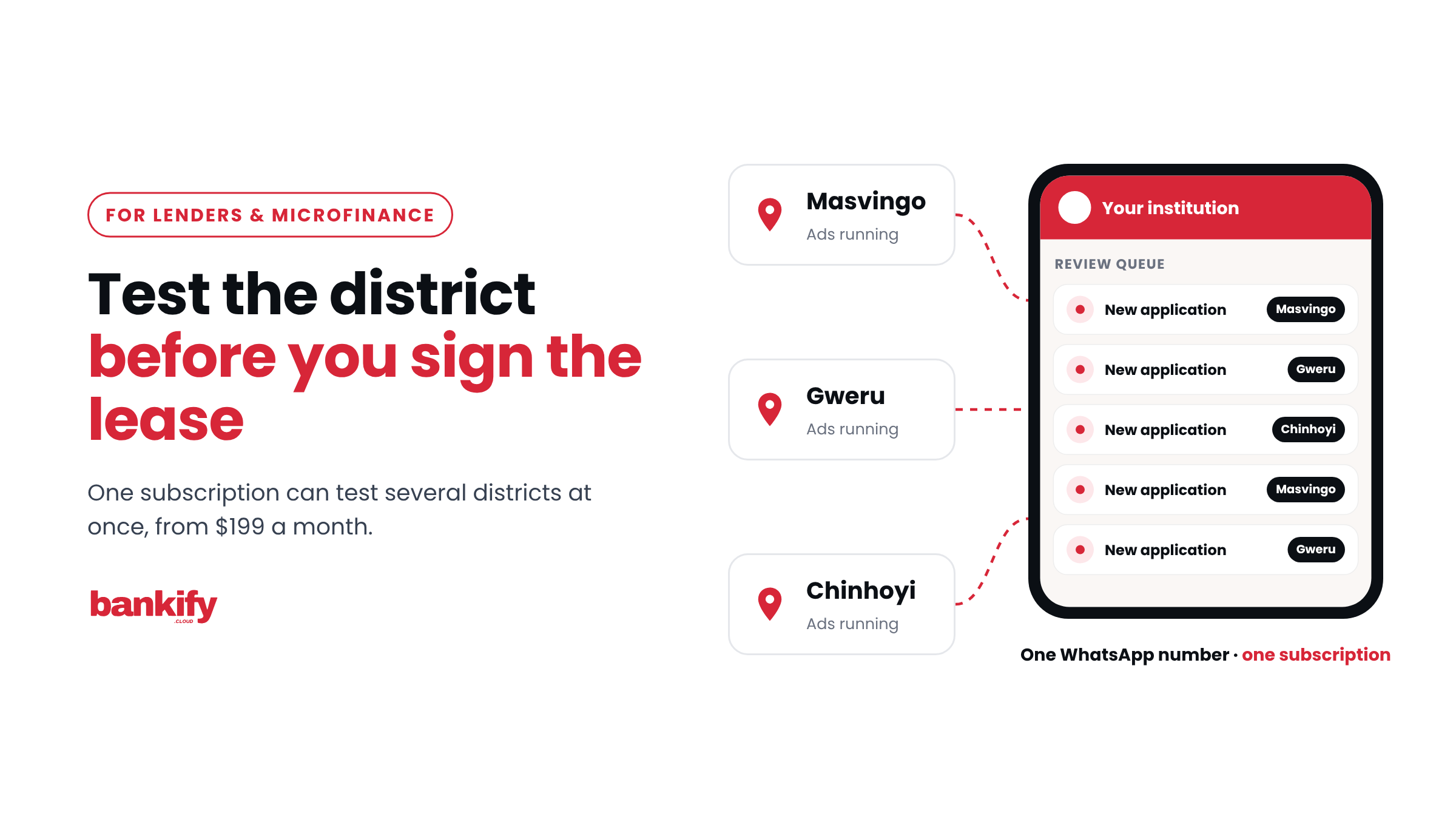
A branch tests one town at a time. A subscription is priced by WhatsApp number and application volume, so the same plan can test as many districts as you choose to advertise in, all at once.
Three districts, one subscription
Ads in Masvingo, Gweru and Chinhoyi
One campaign per district
One WhatsApp number
One subscription
One review queue
Each borrower's address shows the district
The next branch
Where the applications point
Run the three campaigns side by side for a month and compare the applications from each district. Starter's 300 applications a month are shared across every district you advertise in, and you're notified at 80% and 100% of the allowance, so a district that takes off doesn't switch anything off.
Test the district before you sign the lease
The question a lease asks is "will enough borrowers here apply?" A digital front door lets you answer it with applications instead of a forecast.
Branch first
- Sign the lease
- Hire the staff
- Wait for borrowers
- Learn the demand
Demand first
- Open on WhatsApp
- Advertise in the district
- Count the applications
- Lease where it pays
Every borrower gives a residential address when they enrol, so you can see which districts your applications come from. Run a few weeks of local advertising in each district pointing at your WhatsApp number, and you'll know which needs a branch, which a field officer twice a week, and which nothing yet.
Run your own numbers
Your branch costs and loan margins are your own. This takes an afternoon with your finance lead:
Branch vs digital front door, in five steps
Cost a year of the new branch
Add the lease, fit-out, salaries, security and running costs for the first twelve months.
Count the loans that branch must write
Divide that cost by the income you earn on an average loan. That's the number the branch needs just to cover itself.
Cost a year of the digital front door
Take the subscription and setup fee from the pricing page, plus the time your existing officers spend reviewing applications.
Compare the two
Put the number of loans each option needs side by side.
Set the bar for the lease
Decide how many applications a month from a district would justify a branch, test your shortlist at once, and sign where you see them.
What the branch is still for
A digital front door tells you where to build; the branch does what only a branch can. Group meetings, collections visits, cash and the relationships that keep a loan book healthy still happen in person. When you open that branch, it starts with a queue of borrowers who have already applied.
See what it costs for your institution. Compare the plans on the pricing page, or book a 15-minute walkthrough and we'll show you how applications from a new district would arrive in your queue. If you missed the earlier articles in this series, start with Your Branch Closes at 4:30. Your Borrowers Don't.
Next in this series: WhatsApp, Messenger, Web Chat or an App? Choosing Your Self-Service Channels.