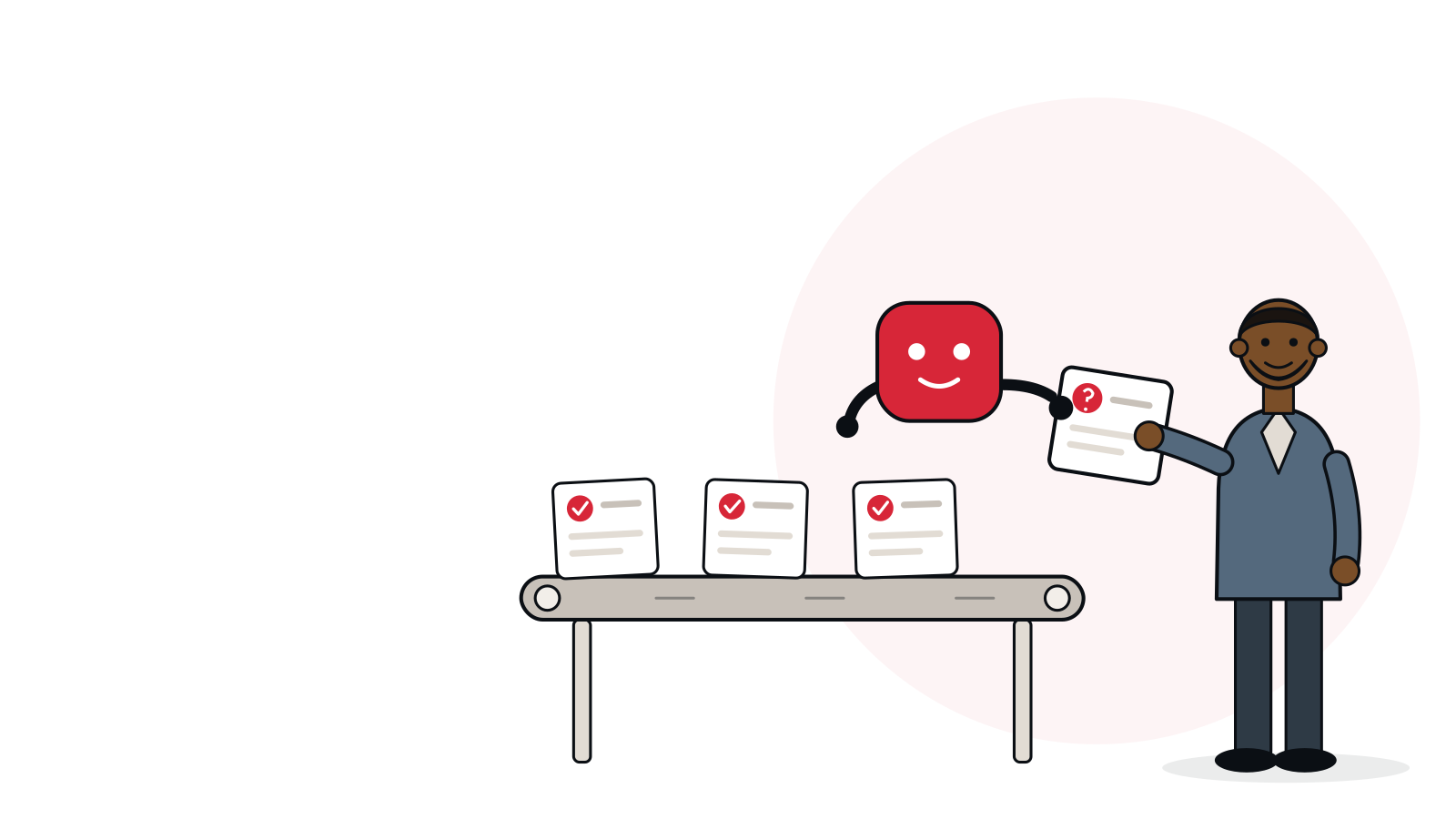

Most microfinance lenders are already onboarding customers over WhatsApp. They are just not doing it on purpose. A loan officer hands out a personal number, the ID photo and the payslip arrive in a personal chat, and someone assembles the file afterwards by hand. Printed, stapled, filed.
That works right up until somebody asks to see the file.
This is the part of the lending stack that rarely gets modernised, because it does not look like infrastructure. It looks like how things have always been done. But the cabinet, the back-office server and the branch-hours queue are infrastructure, and they are the reason growth costs more than it should.
What an ageing lending stack actually costs you
A server in the back office
Bought once, patched rarely, and holding the entire loan book.
Files that live on paper
Assembled by hand, after the fact, from chats and scans.
Branch hours
Customers can only be onboarded while a branch is open and staffed.
Nothing to show an inspector
No record of what was collected, when, or by whom.
On-premise does not scale, it accumulates
An on-premise lending system asks you to buy capacity before you have the customers to justify it. Every new branch is another installation. Every update is a visit. Every report is a request to the one person who knows how the database is laid out.
None of that is dramatic on its own. The effect is cumulative. The institution grows, the stack does not, and the gap between them is filled by staff doing manual work that nobody planned for and nobody costs.
What moving the stack actually changes
Cloud-hosted lending infrastructure removes the hardware question entirely. There is no server to buy, no installation per branch, and no maintenance window that has to be negotiated with the business. A branch manager in another town opens the same system the head office does, on the same day it is updated.
The bigger change is visibility. When applications, documents and repayments are all captured in one place, portfolio performance stops being a month-end reconstruction and becomes something you can look at on a Tuesday afternoon.
The old file
- A personal chat
- Printed and stapled
- A filing cabinet
- Found eventually
The new file
- One guided chat
- Verified on submission
- Always retrievable
Onboarding is where the file is won or lost
If the documents still arrive by personal message, a cloud loan book only relocates the problem. The file has to be built correctly at the point the customer hands something over, which means the conversation itself has to do the collecting, the consent and the checks.
The channel does not need to be invented. Customers already message businesses on WhatsApp, and they will do it after hours, from wherever they are, without being asked to come in.
What a compliant WhatsApp application looks like
Every one of those answers lands in the same structured record, with a timestamp and the document attached to it. That is the difference between a chat and an onboarding system.
It has to hand off to the loan book you already run
Replacing a core lending system is a project. Fixing the front of it is not, and most institutions should not have to do the first in order to get the second. Onboarding should capture and verify, then pass a complete application into whatever loan management system you run today.
Where onboarding ends and your loan book begins
Customer
WhatsApp
Bankify
Consent, KYC checks, document capture
Your LMS
Credit decisions, unchanged
What this does not fix
It is worth being clear about the limits. A digital front door does not improve your credit policy, and it will not rescue a book with an arrears problem. Customers with poor connectivity still struggle, and staff who have spent years working from paper need a fortnight of patience, not a training slide. Historical files still have to be migrated, and that is real work.
What it does fix is the gap between the moment a customer decides to apply and the moment you have a file you can stand behind.
Bankify runs the onboarding layer on WhatsApp, mobile, Messenger and web chat, and hands finished applications to your existing lending system. Setup typically takes about two weeks.